Diet Dialogues Podcast companion experience
Episode companion
Gut health
Research snapshots
Season spotlight

What actually moves the needle for gut health?

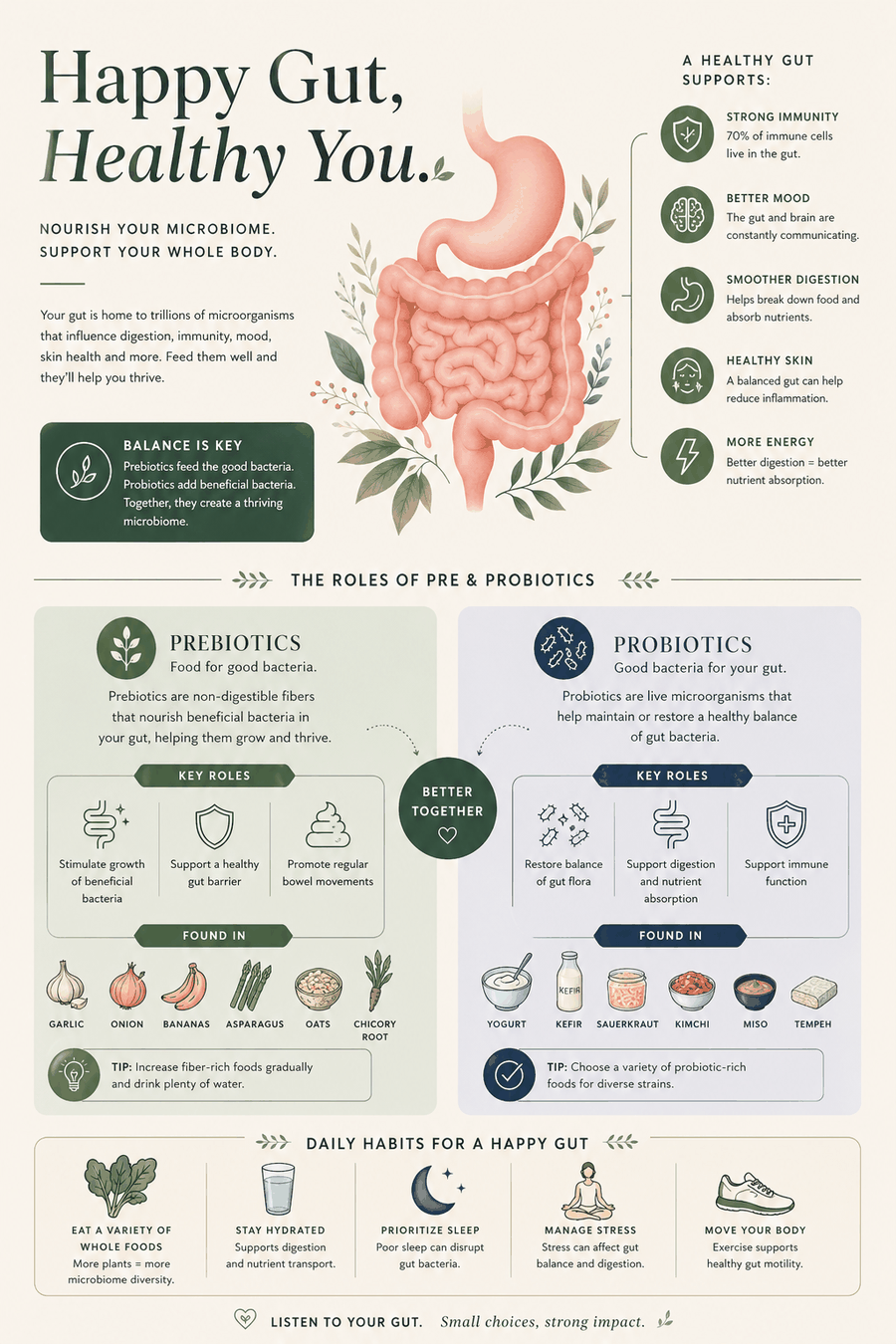
This episode companion explores a conversation about prebiotics, probiotics, fermented foods, and the everyday habits that shape digestion. It pulls the research into a clean, readable format with infographics, comparison tables, listener-style quotes, and reflection prompts.

Evidence map

Comparing common gut-health strategies

The episode frames gut health as a set of levers. Some interventions show steadier signals in reviews, while others are promising but more strain-specific or dependent on the person.

Strategy What the research tends to show Best fit Main caveat
Mediterranean-style eating Broadly linked to a healthier gut pattern, more SCFA-producing bacteria, and lower inflammatory markers. People who want a durable, food-first foundation. Benefits come from the full pattern, not a single ingredient.
Fiber and whole grains Consistently support regularity and microbiome structure, especially when intake increases gradually. Constipation, irregularity, and low-fiber diets. Too much too fast can cause bloating or discomfort.
Fermented foods Can increase microbial diversity and may reduce some inflammatory signals in healthy adults. People who tolerate dairy or fermented vegetables well. Effects depend on the food and the serving pattern.
Prebiotics Selective fibers can increase beneficial bacteria and support stool quality, with mixed tolerance. People who want a targeted fiber boost. Gas and bloating are common when doses are too high.
Probiotics Evidence is strain-specific and mixed, but some strains help certain GI symptoms. People with a defined symptom target or a clinician-guided plan. One probiotic does not generalize to all probiotics.
Hydration, movement, sleep Support digestion and regularity indirectly, but are usually not standalone microbiome interventions. Anyone building the basics first. Helpful, but usually not the whole answer.
Infographic

Research-synthesis snapshot

These scores are an editorial synthesis of the research conversation. They are designed to communicate relative strength and consistency, not exact head-to-head superiority.

Gut health strategies, ranked by consistency signal

A visual summary of where the evidence is strongest across current reviews and trials: broad dietary patterns and fiber tend to be steadier than any one supplement alone.

What to notice Pattern-level changes usually outperform single “fixes,” and fermented foods, fiber, and a Mediterranean-style diet keep showing up near the top.
Chart 1

Evidence consistency score

Illustrative synthesis from reviews and trials

Pattern Fiber Fermented Prebiotics Probiotics 92 90 84 78 68
Broad, pattern-level benefit Targeted but mixed evidence Food-first signal

In the episode framing, the strongest signal comes from eating patterns and fiber, while supplements are more likely to be strain- or person-specific.

Chart 2

Outcome profile by strategy

Microbiome, regularity, and symptom comfort

Mediterranean Fermented foods Fiber / whole grains Probiotic capsules Diversity Regularity Comfort Strain-specific high medium moderate mixed
Diversity Regularity Comfort

Different strategies tend to help different outcomes. The episode leans on that distinction rather than promising one universal “best” choice.

Pull quotes

What stood out in the room

These quote-style highlights capture the tone of the episode: curious, practical, and a little skeptical of miracle claims.

Clinical lens

“The big question isn’t whether one probiotic is magic. It’s whether the person, the strain, and the symptom all line up.”

Gut health is usually specific, not universal.
Food-first voice

“Once I stopped searching for a supplement to fix everything, I started noticing that my meals were doing more of the work.”

Pattern changes often matter more than any single capsule.
Reality check

“If the goal is better digestion, then consistency, fiber, and tolerance usually beat the flashiest label.”

The episode favors durability over hype.
Insights

What the conversation suggests

These takeaways summarize the research-oriented side of the episode and translate it into plain language.

Broad patterns usually win.

A Mediterranean-style diet and steady fiber intake are the most dependable “foundation” interventions.

Prebiotics are targeted fiber.

They can selectively feed beneficial bacteria, but dose and tolerance decide whether they feel helpful.

Probiotics are strain-specific.

One strain may help one symptom while another does nothing, so the label matters almost as much as the brand.

Why this matters: gut health usually improves through a stack of small habits and a food pattern that a person can actually repeat, not through a single “magic” product.
Listener prompts

Questions to sit with after the episode

Use these prompts for reflection, a discussion guide, or a social post caption.

What is the real problem?

Is it constipation, bloating, irregularity, discomfort, or just wanting to “support the microbiome”?

What would be sustainable?

Would you actually keep eating the intervention after the novelty wears off?

What needs a clinician?

If symptoms are persistent, painful, or changing, is it time to get a proper workup instead of self-experimenting?

Quiz

Gut-health general knowledge check

Ten quick questions based on the episode themes and the broader gut-health conversation.

Answered: 0 / 10
Educational quiz
General knowledge

This quiz is for learning and reflection only, not medical advice.